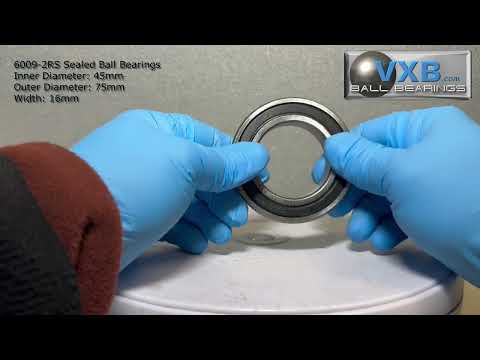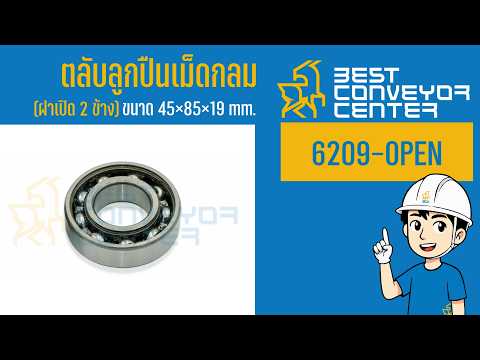
_1788256344_WNo_800d800.jpg)
Image may differ from product. See technical specification for details.
6209 Deep Groove Ball Bearing is a standard single-row deep groove ball bearing in the CXJSD 6200 series, featuring a 45 mm bore, 85 mm outside diameter, and 19 mm width. According to CXJSD's official specifications, the 6209 has a minimum chamfer dimension of 1.1 mm, a dynamic load rating of 32.5 kN, a static load rating of 20.4 kN, and contains 10 balls with a 12 mm ball diameter. Its reference speed is 7,800 r/min with grease lubrication and 9,200 r/min with oil lubrication, with a unit weight of approximately 0.398 kg.
The CXJSD 6209 is a single-row deep groove ball bearing with a 45 mm bore, 85 mm outside diameter and 19 mm width. The following values correspond to the CXJSD 6209 specification supplied for this product.
| Specification | 6209 Deep Groove Ball Bearing |
|---|---|
| Bearing Number | 6209 |
| Bearing Type | Single-Row Deep Groove Ball Bearing |
| Bore Diameter (d) | 45 mm |
| Outside Diameter (D) | 85 mm |
| Width (B) | 19 mm |
| Minimum Chamfer Dimension (r) | 1.1 mm |
| Basic Dynamic Load Rating (Cr) | 32.5 kN |
| Basic Static Load Rating (Cor) | 20.4 kN |
| Number of Balls | 10 |
| Ball Diameter | 12.0 mm |
| Reference Speed with Grease Lubrication | 7,800 r/min |
| Reference Speed with Oil Lubrication | 9,200 r/min |
| Weight | 0.398 kg/pc |
The 6209 uses the standard deep groove ball bearing configuration, with inner and outer raceways, steel balls and a cage. Its deep raceway geometry allows the bearing to accommodate radial loads and axial loads in both directions.
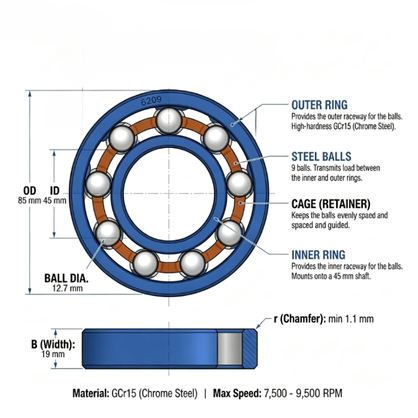
The inner ring has a 45 mm bore and fits around the shaft. Its internal raceway provides the rolling path for the steel balls.
The outer ring has an 85 mm outside diameter and forms the outer raceway in which the balls rotate.
The CXJSD 6209 uses 10 steel balls with a 12.0 mm ball diameter as the rolling elements between the two raceways.
The cage keeps the steel balls evenly spaced and guides their movement during bearing rotation.
The deep circular raceways allow the 6209 to support radial loads and axial loads in both directions.
The 6209 has a 1.1 mm minimum chamfer dimension at the ring edges to provide the specified edge clearance.
The raceway is exposed on both sides. This configuration can be suitable where the bearing is protected by the surrounding equipment and external lubrication is required.
Metal shields on both sides help limit the entry of dust and retain factory-applied grease while adding relatively little contact drag.
Rubber contact seals on both sides provide stronger protection against moisture and fine contaminants. The exact configuration should be confirmed by the bearing suffix.
The 6209's 45 mm bore, 85 mm outside diameter and 19 mm width make it suitable for a range of rotating equipment. Actual bearing selection should be based on load, speed, temperature, fit, lubrication and operating environment.
Used to support rotating shafts in motors, fans and blowers where smooth rotation and reliable radial load support are required.
Supports rotating shafts in pumps and compressors while accommodating radial loads and the axial loads generated during operation.
Provides shaft support in gearboxes and industrial equipment requiring dependable rolling performance under continuous mechanical loads.
Supports rotating shafts and pulley-related components in conveyor and material-handling equipment operating under continuous radial loads.
Can be applied to rotating shafts in agricultural and textile machinery where the 6209 dimensions and load requirements match the equipment design.
Common buyer feedback and purchasing considerations when evaluating 6209 deep groove ball bearings for replacement, maintenance, and industrial equipment applications.
The first thing we checked was the size. Our equipment called for a 45 mm bore, 85 mm outside diameter and 19 mm width, so the 6209 was easy to compare with the bearing already installed. That saved us a lot of time during replacement planning.
For our application, running stability was more important than simply finding a bearing with the right dimensions. The 6209 is a standard deep groove design, so it works well for shaft support where smooth rotation and both radial and axial load capability are needed.
We paid close attention to the load rating because the bearing was going into continuously operating equipment. The 6209 has a 32.5 kN basic dynamic load rating and a 20.4 kN basic static load rating, which gave us useful data for checking the application.
What I like about the 6209 is that there are several configuration points to consider depending on the application. Open, shielded and sealed versions can serve different working conditions, so we normally confirm contamination, lubrication and speed before quoting a replacement.
For batch purchasing, consistency is a big concern. We normally compare the bearing number, dimensions, load ratings, clearance, sealing and lubrication requirements before placing a larger order. Having all of those details confirmed up front makes repeat purchasing much easier.
Selected videos covering 6209 deep groove ball bearings, including their dimensions, configurations and common application considerations.
Quick answers to the questions buyers commonly consider when selecting a 6209 bearing, including seal configuration, C3 clearance, replacement compatibility, noise and service life.
_1789954680_WNo_900d429.jpg)
6209 normally refers to the open bearing configuration, while 6209-2RS uses contact seals on both sides and 6209-2Z/ZZ uses metal shields on both sides. The correct version depends mainly on contamination protection, speed, lubrication, and operating conditions.
_1789954694_WNo_900d429.jpg)
C3 means greater-than-normal radial internal clearance. A 6209 C3 bearing can be appropriate where operating temperature, thermal expansion, interference fits, or operating conditions require additional internal clearance, but C3 should not be selected automatically for every application.
_1789954706_WNo_900d429.jpg)
A 6209 bearing from another manufacturer may share the 45 × 85 × 19 mm boundary dimensions, but this does not guarantee identical performance. Check the load ratings, speed ratings, internal clearance, sealing, precision class, cage design, and lubrication before making a substitution.
_1789954717_WNo_900d429.jpg)
Common causes include incorrect installation, contamination, insufficient or excessive lubrication, improper fit, excessive load, misalignment, or bearing damage. If a new 6209 bearing becomes noisy quickly, check the shaft and housing condition as well as installation and lubrication rather than assuming the bearing itself is the only cause.
Use the correct bearing configuration and fit, keep the bearing clean, apply the appropriate lubricant and quantity, avoid excessive loads and speeds, and install it with the correct tools and alignment. Regularly monitoring temperature, noise, vibration, and lubrication condition can also help identify problems early.