
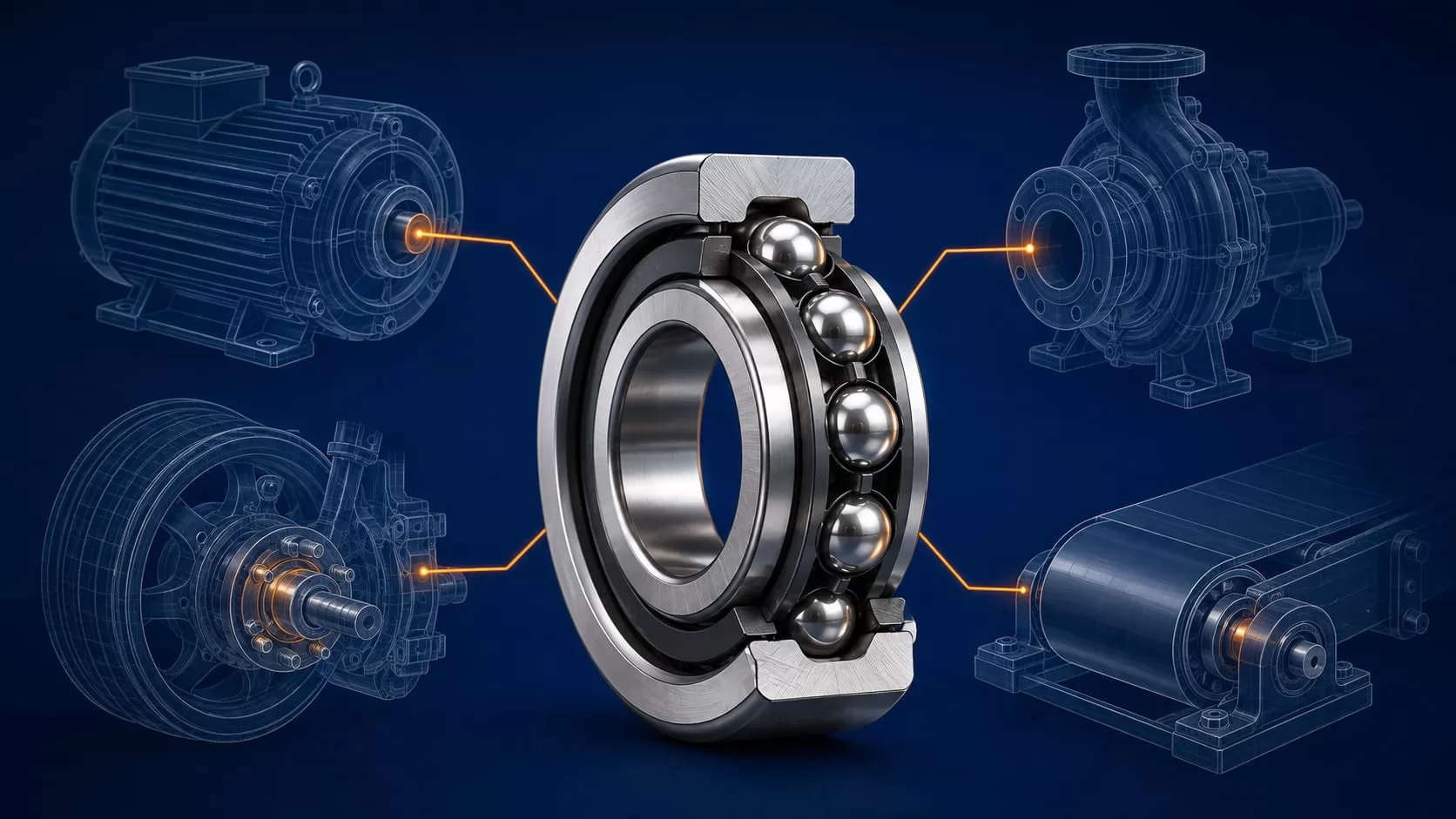
Deep groove ball bearings are the most widely used rolling bearings in the world — and also the most frequently over-specified. Buyers often default to a premium sealed bearing with tight clearance "just to be safe," paying more per unit and locking up cash in inventory that doesn't match the actual operating conditions. Understanding what deep groove ball bearings are used for, and which series fits which application, is the single easiest way to cut procurement cost without sacrificing reliability.
This guide breaks down deep groove ball bearing applications by industry and operating condition, and explains exactly which bearing type to specify for each — so you stop paying for performance you don't need.
A deep groove ball bearing has raceways with a groove deep enough to accept a full complement of balls, which is what lets it carry both radial and moderate axial (thrust) loads at the same time. That combination — plus low friction, low noise, high speed capability, and simple maintenance — is exactly why deep groove ball bearing applications span almost every industry that uses rotating machinery: electric motors, pumps, gearboxes, household appliances, automotive components, agricultural equipment, and industrial automation.
In practice, "deep groove ball bearing" is not one product — it's a family. The right series depends on load direction, speed, contamination risk, temperature, noise tolerance, and expected service life. Below is where each type earns its keep.
This is the single largest application category. Motor bearings typically see moderate radial load, high rotational speed, and need low noise and low friction to keep energy losses down.
Washing machines, blenders, vacuum cleaners, and fans need compact, quiet, maintenance-free bearings that survive years without service.
Alternators, water pumps, wheel hubs, and small gearboxes all rely on deep groove ball bearings, but load and speed vary a lot by position.
Pumps combine radial load from the shaft with some axial thrust from impeller action, plus significant heat.
Dusty, wet, high-vibration environments where contamination — not load — is usually what kills the bearing first.
Continuous operation, moderate speed, and often heavier radial loads from belt tension and material weight.
Here, precision and low runout matter more than raw load capacity.
High speed, light-to-moderate load, and noise sensitivity (these machines often run near operators).
The single row deep groove ball bearing application covers the vast majority of uses — motors, pumps, fans, general machinery — anywhere radial load is moderate and axial load is light to moderate in both directions.
One row of balls carries radial load plus moderate axial load in both directions
Two rows of balls raise radial load capacity within the same bore/OD envelope
A double row deep groove ball bearing is worth the extra cost only when:
A double row deep groove ball bearing is worth the extra cost only when:
If space isn't constrained, a larger single row bearing is usually cheaper than a double row bearing of the same load rating — a detail that's easy to miss when specifying by "upgrade" instinct rather than by calculation.
This is where most unnecessary spending happens:
| Type | Best for | Avoid when |
|---|---|---|
| Open | Housings that already seal/protect the bearing (motors, gearboxes with their own seals), applications needing custom relubrication | Environment has any dust/moisture exposure |
| Shielded (ZZ) | Light contamination protection, applications with clean, dry conditions | Wet or heavily contaminated environments — shields aren't a true seal |
| Sealed (2RS/RS) | Lifetime-lubricated components, wet/dirty/dusty environments, appliances | Very high speed applications, since rubber seals add friction and a speed limit |
| Application | Recommended Series Type | Seal Type | Clearance |
|---|---|---|---|
| Electric motors / fans | Single row | Open or ZZ | C3 |
| Household appliances | Single row, small bore | 2RS | C0 |
| Automotive alternator | Single row, high-speed grade | 2RS (HT grease) | C3 |
| Pumps / compressors | Single row | Open (oil lube) | C3 |
| Agricultural machinery | Single or double row | 2RS / 2Z | C3 |
| Conveyors / material handling | Single or double row | 2RS/ZZ (housed unit) | C3 |
| Machine tool spindles | Single row, precision grade | Open | Per spindle design |
| Textile / light industrial | Single row | ZZ or open | C0/C3 |
Deep groove ball bearings are used for supporting rotating shafts under combined radial and moderate axial loads in equipment such as electric motors, pumps, gearboxes, automotive components, household appliances, and general industrial machinery.
Single row deep groove ball bearings are used in the majority of general-purpose rotating equipment — motors, fans, pumps, and light-to-moderate load machinery — anywhere a compact, low-friction bearing needs to handle radial load plus some axial load in both directions.
Yes. With the appropriate cage material and lubrication, deep groove ball bearings are well suited to high-speed applications such as motor spindles and textile machinery, which is one reason they're specified more often than roller bearings in speed-sensitive equipment.
Yes, deep groove ball bearings are designed to carry moderate axial load in both directions in addition to radial load, which is what distinguishes them from bearings designed for pure radial or pure thrust duty.

Explore the pros, cons, and typical applications of deep groove ball bearings. Learn how to choose the right type for motors, pumps, and industrial machinery.

A procurement-focused guide to 10 trusted deep groove ball bearing factories in China — company background, specialties and how to pick the right DGBB supplier for your application

Compare the top 10 deep groove ball bearing manufacturers and suppliers for 2026 — SKF, NSK, NTN, Timken, Schaeffler & more. Get specs, MOQs & a fast quote today.