
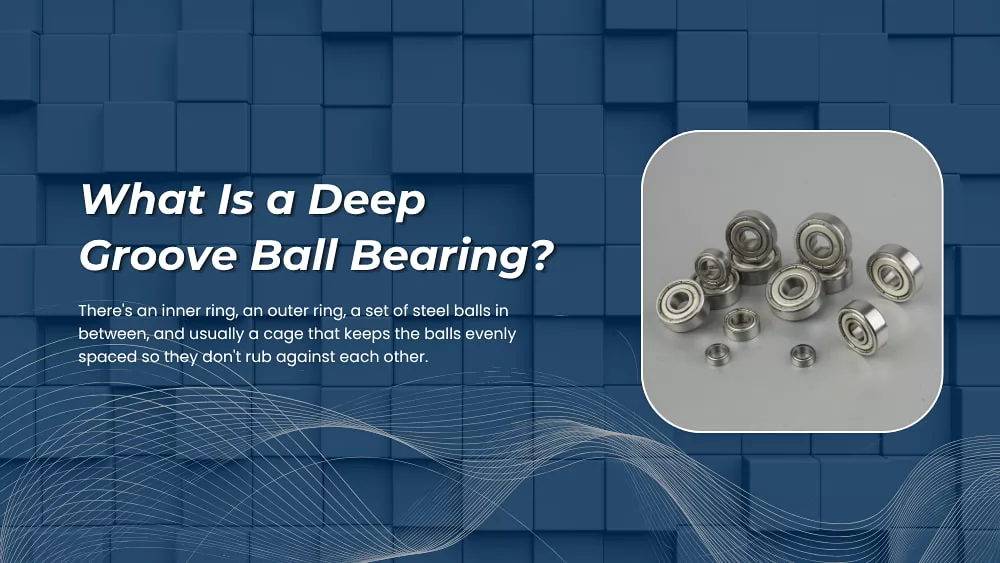
Take almost any machine apart — a motor, a fan, a pump, even a bicycle hub — and there's a good chance a deep groove ball bearing is sitting somewhere inside it. It's the most common bearing type in the world, not because it's the strongest or the most precise, but because it does a reasonably good job at almost everything. That combination of simplicity and versatility is really the whole story here, so let's go through it properly: what it is, how it's built, where it shines, where it doesn't, and how to actually pick the right one instead of just guessing from a catalog.
Structurally, it's fairly simple. There's an inner ring, an outer ring, a set of steel balls in between, and usually a cage that keeps the balls evenly spaced so they don't rub against each other. The part that gives this bearing its name is the raceway — the groove that the balls roll along on both rings. Instead of being shallow, that groove is cut deep, curving around the ball almost as far as the ball's own radius allows.
That deep curvature is what separates this bearing from most others. A shallow groove can really only resist force pushing straight down onto it (radial load). A deep groove, because it wraps further around the ball, can also resist force pushing sideways along the shaft (axial load), in either direction. So with one design, you get a bearing that handles two different kinds of load at once — which is a big part of why it ended up becoming the default choice across so many industries.
There are a few reasons this bearing became the "default" option rather than just one option among many:
| Advantage | Why it matters |
|---|---|
| Combined radial and axial load capacity | One bearing can do the job that would otherwise need two separate specialized bearings, simplifying the whole assembly. |
| Low friction, high speed capability | Ball-to-raceway contact is a point contact rather than a line contact, so friction and heat generation stay relatively low even at high RPM. |
| Simple structure, low cost | Fewer parts and a straightforward manufacturing process keep production costs down, so it's widely and cheaply available in almost any size. |
| Low noise and low maintenance | Sealed or shielded versions come pre-lubricated for life, so there's no routine greasing required in most consumer and light industrial equipment. |
| Wide availability | Standardized dimensions (6000, 6200, 6300 series, etc.) mean replacements are easy to source from almost any bearing manufacturer worldwide. |
None of this makes it a universal solution, though. It has real limitations, and it's worth being upfront about them rather than treating this bearing as if it can do everything:
| Limitation | What it means in practice |
|---|---|
| Lower load capacity than roller bearings | Because contact with the raceway is a small point rather than a line, it can't carry nearly as much radial load as a cylindrical or tapered roller bearing of the same size. |
| Limited shock resistance | Sudden, heavy impact loads can cause point-loading damage (brinelling) on the raceway faster than in bearings designed for that kind of stress. |
| Not ideal for heavy one-directional thrust | It can handle axial load, but only up to a point — applications with strong, sustained thrust in one direction are usually better served by angular contact or thrust bearings. |
| Precision positioning is limited | Because it isn't preloaded like an angular contact bearing, it isn't the first choice where very tight axial positioning accuracy is required, such as in some machine tool spindles. |
Given that balance of strengths and weaknesses, deep groove ball bearings tend to show up wherever moderate loads, moderate-to-high speeds, and cost-efficiency all matter more than extreme performance in any single direction. That covers a surprisingly broad list: electric motors, household appliances (fans, washing machines, vacuum cleaners), pumps, gearboxes, conveyor systems, HVAC equipment, automotive accessories, and general industrial machinery. Anywhere a shaft just needs to spin smoothly and reliably without facing extreme shock loads or requiring high-precision axial control, this is usually the bearing engineers reach for first.
Once you know you actually need this bearing type, the next question is which specific variant fits your application. A few factors decide that, and it's worth going through them in order rather than picking based on price or bore size alone.
1. Load direction and magnitude. Check both the radial and axial load your application generates, and compare that against the manufacturer's rated dynamic and static load values — never assume a larger bore automatically means a stronger bearing.
2. Operating speed. Higher-speed applications benefit from open or shielded (ZZ) designs, since shields create less drag than rubber seals. Lower-speed but dirtier environments usually favor sealed (2RS) designs instead, since the seal keeps out dust and moisture more effectively.
3. Operating environment. Humidity, dust, chemical exposure, and temperature all affect the choice of sealing type and material. Standard chrome steel (GCr15) works for most environments, but stainless steel versions are worth considering for washdown, food-processing, or corrosive settings.
4. Precision requirements. Standard tolerance classes are sufficient for general machinery. Precision equipment — high-speed spindles, precision instruments — may call for a tighter tolerance class (ABEC or ISO P-grade), which does come at a higher cost.
5. Mounting and clearance. Internal clearance (C2, CN, C3, C4, etc.) affects how the bearing behaves under thermal expansion. Applications running hot may need a larger internal clearance than the standard default to avoid excessive preload once the bearing heats up.
A quick way to decode a standard part number, since this trips a lot of people up: in something like 6205-2RS, the "62" indicates the series (a medium-duty deep groove design), and the last two digits multiplied by 5 give the bore diameter in millimeters — so 6205 has a 25mm bore. The "2RS" indicates rubber seals on both sides, while "ZZ" would mean metal shields instead.
Q: Can a deep groove ball bearing handle both radial and axial loads at the same time?
Yes — that's really its defining feature. It handles radial loads well and moderate axial loads in either direction simultaneously, which is why it's used so broadly across different types of equipment.
Q: What's the difference between open, shielded (ZZ), and sealed (2RS) bearings?
Open bearings have no protection and need external sealing in the housing design. Shielded (ZZ) bearings have metal shields that reduce contamination while keeping friction low. Sealed (2RS or 2RZ) bearings have rubber seals that block dust and moisture more effectively but create slightly more drag, which can matter at very high speeds.
Q: How long do deep groove ball bearings typically last?
Service life depends heavily on load, speed, lubrication, and contamination, so there's no single number that applies everywhere. Manufacturers publish an L10 rating (the calculated life that 90% of a batch should reach under given conditions), which is the figure worth asking for when comparing options for a specific application.
Q: When should I choose a different bearing type instead?
If your application involves very heavy radial loads, strong shock loading, or requires precise one-directional axial positioning, a cylindrical roller bearing, tapered roller bearing, or angular contact bearing is usually a better fit than a deep groove ball bearing.
Q: Do deep groove ball bearings need regular lubrication?
Sealed and shielded versions come pre-greased and are designed to run maintenance-free for their service life in most general applications. Open bearings, on the other hand, typically require scheduled relubrication depending on operating conditions.
Q: What material are they usually made from?
Standard chrome steel (GCr15) covers the vast majority of applications. Stainless steel versions are available for corrosive, washdown, or food-grade environments where standard steel would corrode too quickly.

Explore the pros, cons, and typical applications of deep groove ball bearings. Learn how to choose the right type for motors, pumps, and industrial machinery.

A procurement-focused guide to 10 trusted deep groove ball bearing factories in China — company background, specialties and how to pick the right DGBB supplier for your application

Compare the top 10 deep groove ball bearing manufacturers and suppliers for 2026 — SKF, NSK, NTN, Timken, Schaeffler & more. Get specs, MOQs & a fast quote today.